Key takeaways
- A clean-water loss caught the same day usually dries in three to five days. Contaminated water, dense materials, and late discovery add time.
- Dry means the framing and subfloor reach a measured dry standard, not that the carpet feels dry.
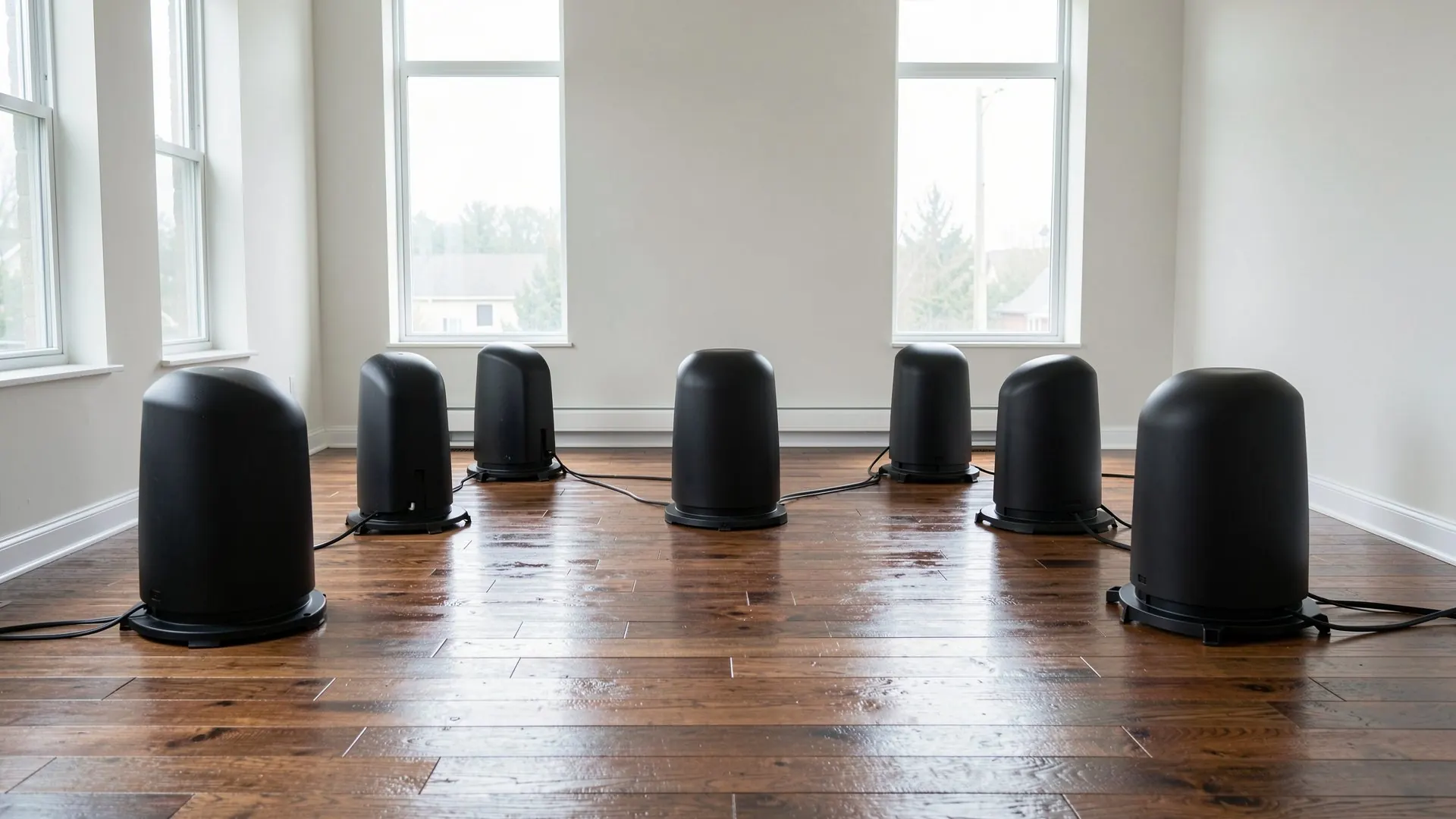
- Air movers and dehumidifiers need to run continuously. Turning them off at night slows the job and can restart mold growth.
- Daily moisture readings are the proof that the drying is working. Ask to see them.
The short answer
For a typical Iowa home with a clean-water loss in one or two rooms, professional drying takes about three to five days. That is the number most restoration crews plan around, and it assumes the water is extracted on the first visit, the equipment runs continuously, and the materials are the kind that can be dried in place.
The number moves when any of those assumptions change. A finished basement that took on groundwater, a crawlspace with soaked insulation, or a leak that ran for a week before anyone noticed can take a week or longer. A sewage backup is a different job altogether: contaminated material comes out, and the rebuild starts after the structure is clean and dry.
The useful question is not "how many days?" It is "what has to be dry, and how will we know?"
What "dry" actually means
Drywall, wood framing, and subfloor all hold some moisture in a normal, healthy house. The goal is not zero. The goal is a dry standard: a moisture content close to what the same material reads in an unaffected part of the home.
Technicians take a baseline reading in a dry room and compare it to the wet area. They use a pin meter for wood and drywall, and a thermal camera to see the temperature differences that suggest hidden moisture. Readings are logged daily, along with the equipment placement, the temperature, and the relative humidity.
That log is the difference between "it feels dry" and "it is dry." Carpet can feel dry while the pad and the subfloor below it are still holding water. A baseboard can feel dry while the drywall behind it is damp. The meter is the arbiter.
Seven factors that move the timeline
1. The water category
Clean water from a supply line is the simplest job. Water that came through a foundation wall or up through a floor drain is treated as contaminated, and porous materials that cannot be cleaned are removed rather than dried. Sewage is the most serious category and always means removal and disposal.
2. How long the water sat
The clock starts when the water arrives, not when someone notices. A leak that ran for a weekend has more time to wick into framing, insulation, and subfloor. It also has more time for mold to begin. If the loss is more than 48 hours old, ask about a mold assessment along with the drying.
3. The materials
Carpet and pad dry relatively quickly. Engineered flooring, laminate, cabinet cores, and plaster release moisture slowly. Hardwood can sometimes be dried in place with mats, but it takes longer and the floor may still need refinishing. Dense materials are the main reason a job runs past five days.
4. The size and layout
A single room with an open doorway dries faster than a finished basement with several small rooms. Water travels through joist bays and wall cavities, so the wet footprint is often larger than the visible puddle. More rooms mean more equipment and more days.
5. The equipment
Drying is a math problem: air movement, dehumidification, and temperature have to be sized to the wet area. A couple of household fans and a portable dehumidifier will not dry a building assembly. A crew that brings enough equipment and monitors it daily will finish faster than one that undersizes the job.
6. The season
An Iowa summer gives you warm, humid air. The dehumidifier has to work harder to pull moisture out of the room. Winter air is drier, but a cold house slows evaporation, and frozen ground changes how water moves around a foundation. The equipment settings should change with the season.
7. What is hidden
The most common surprise is water behind a wall or under a floor that nobody saw. A thermal camera and a moisture meter find it before the drywall goes back. If the hidden cavity is missed, the visible room may read dry while the assembly stays wet.
A realistic day-by-day
Day 1: stop, extract, scope
The source is stopped, standing water is extracted, and the wet area is mapped. Wet carpet and pad may come up. Equipment is placed, and the first readings are recorded. You get a written scope that separates what can be dried from what has to be removed.
Days 2 to 3: the heavy lifting
Air movers and dehumidifiers run continuously. Readings are taken again. The numbers should be falling. If they are not, the equipment may need to be repositioned, or there may be a source that was missed. This is the stage where a daily check matters most.
Days 4 to 5: the finish line
The visible materials are usually dry by now. The technician checks the framing, the subfloor, and the wall cavities against the dry standard. If the numbers are stable, the equipment comes out and the rebuild can be scheduled. If they are not, the equipment stays.
After drying: repair and rebuild
Drywall, trim, flooring, and paint go back after the structure passes the moisture check. This is a separate phase, and it can take longer than the drying itself depending on materials and scheduling. Ask who is responsible for the final moisture check before the reconstruction begins.
Why Iowa seasons matter
Iowa gives a water loss two very different environments. In summer, the air is humid and the dehumidifier is doing most of the work. In winter, the outdoor air is dry but the house may be closed up, and a cold crawlspace or an unheated porch dries slowly. Frozen ground can also push water along a foundation instead of letting it drain away.
The seasonal pattern changes the cause as much as the cure. January is supply-line season: copper and PEX split in cold crawlspaces and exterior walls. The first warm week after a hard freeze is basement season, as frost releases groundwater. Spring is river season, summer is storm and sump season. The drying plan should match the loss, not a generic checklist.
Signs the drying is working, and signs it is not
Good signs: the readings are falling day by day, the musty smell is fading, the equipment is pulling water (the dehumidifier reservoir or drain line is active), and the visible materials are returning to their normal color and texture.
Warning signs: the readings have plateaued, a room still smells damp after several days, the paint or baseboard is bubbling, the floor is still soft, or the dehumidifier is not removing water. Any of those means the scope needs to be rechecked. Do not let equipment be removed just because the room looks dry.
If the job is more than a few days old and mold is visible, the drying and the mold remediation may need to be handled together. Our guide to mold remediation explains what containment involves.
When to call
Call when water is still moving, when it is more than an inch deep, when it is near electrical equipment, when it came up through a drain, or when the ceiling is sagging. Also call when a leak has been running for days without anyone noticing, because that situation needs a mold conversation along with the drying.
One call reaches a live dispatcher at any hour. Describe the source, the depth, and how long the water has been there. The dispatcher routes the call by ZIP code to the closest available independent contractor with the right equipment on the truck.
What to have ready: your address and ZIP code, where the water came from, how deep it is, whether the source is stopped, and whether the wet area is on a slab, over a crawlspace, or in a basement. Those five answers shape the first visit.
Frequently asked questions
Can I speed up drying with household fans?
Household fans move air, but they do not remove moisture from the air. Without a dehumidifier, the water they evaporate stays in the room. They can help with a small spill, but they are not a substitute for professional drying equipment in a real loss.
Do I have to leave during the drying?
Many single-room jobs run with the household in place. People usually relocate when sewage is involved, when mold growth is extensive, or when the noise and heat from the equipment make the space unusable. Ask the contractor up front, and check whether your policy includes additional living expenses.
Why does the crew want to remove drywall if it looks fine?
Drywall can look fine on the surface while the paper facing and the cavity behind it are wet. A flood cut gives the cavity air and lets the framing dry. If the drywall is left in place, the moisture can stay trapped and mold can grow behind it.
How do I know the job is really finished?
Ask for the final moisture readings and compare them to the baseline from a dry area. The readings should be stable and close to the dry standard. A verbal "it's dry" is not the same as a documented dry standard.